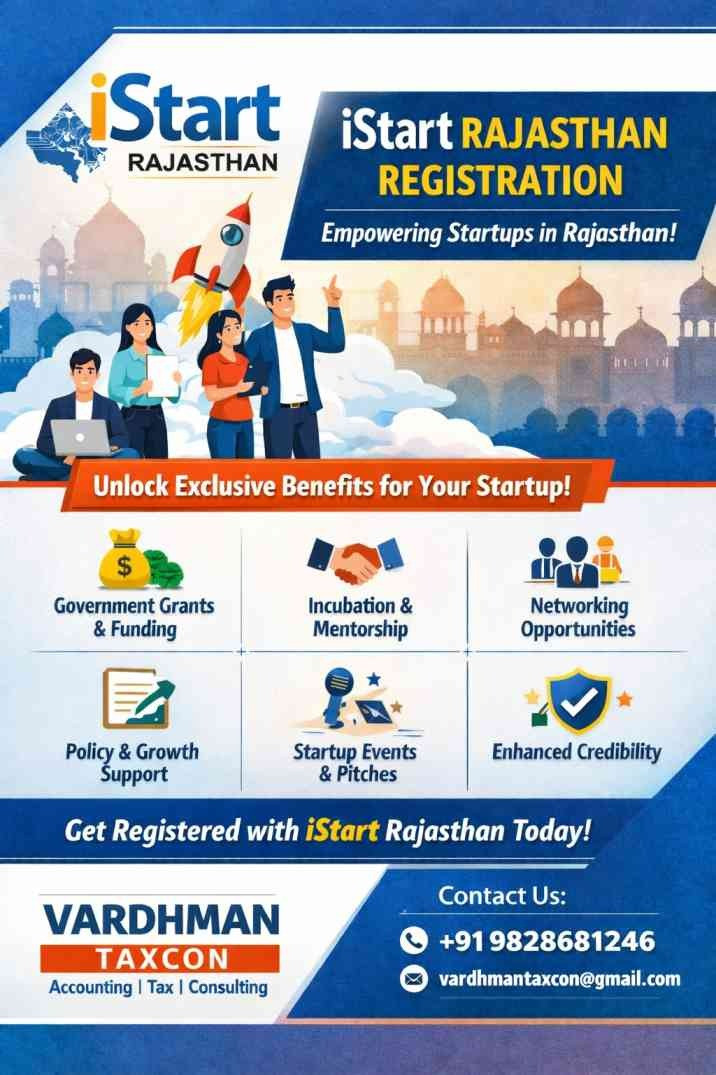
Startup registration in India happens in two main stages:
1. Company Registration (legal entity formation)
2. DPIIT Startup Recognition (to get government startup benefits)
Both are important if you want funding, tax exemptions, and credibility.
STEP 1.: Choose Business Structure
For scalable startups, the most preferred options are:
✅ Private Limited Company (Most Recommended)
Registered via Ministry of Corporate Affairs
Best for:
*Fundraising
*Equity dilution
*ESOPs
*Venture capital
✅Other options:
*LLP (Limited Liability Partnership)
*One Person Company (OPC)
*Partnership (not ideal for tech startups)
👉 90% of funded Indian startups choose Private Limited Company.
STEP 2.: Company Registration Process (MCA)
Registration is done online through MCA portal.
Documents Required:
*PAN & Aadhaar of directors
*Address proof
*Passport-size photo
*Registered office proof
*Rent agreement (if rented)
*NOC from owner
Process:
*Apply for Digital Signature Certificate (DSC)
*Apply for Director Identification Number (DIN)
*Name reservation (SPICe+ Part A)
*File incorporation form (SPICe+ Part B)
*PAN & TAN auto-generated
*Certificate of Incorporation issued
STEP 3.: Apply for Startup India (DPIIT Recognition)
After incorporation, apply through:
Startup India
(Department for Promotion of Industry and Internal Trade – DPIIT)
Eligibility Criteria:
✔ Company age less than 10 years
✔ Turnover below ₹100 crore
✔ Working on innovation / scalable model
✔ Private Limited / LLP / OPC
Documents Required:
✔Certificate of Incorporation
✔PAN
✔Brief business description
✔Pitch deck (sometimes requested)
⏳ Approval time: 2–10 days
Benefits of DPIIT Recognition
💰 1. Tax Exemption (Section 80-IAC)
3-year income tax exemption (if approved by Inter-Ministerial Board)
📉 2. Angel Tax Exemption
🧾 3. Easier Public Procurement Norms
⚖ 4. Self-Certification for:
Labour laws
Environmental laws
💡 5. Fast-Track Patent Filing
STEP 4️⃣: Mandatory Post-Registration Compliances
After registration:
✔ Open Current Bank Account
✔ GST Registration (if turnover > ₹40 lakh / ₹20 lakh services)
✔ Professional Tax (state dependent)
✔ Shops & Establishment License
✔ Accounting & ROC Compliance
Annual Compliance for Pvt Ltd
2 Board Meetings (minimum)
Annual General Meeting
ROC Annual Filing (AOC-4 & MGT-7)
Income Tax Return
Auditor appointment (mandatory)
Register if:
You plan to raise funding
You are co-founding
You want ESOPs
You need contracts/invoices
You're building long-term
You may delay if:
Just testing idea
No revenue
Solo freelancing
Pro Tips (Very Important)
✅ Always sign a Founder Agreement
✅ Decide equity split clearly
✅ Register trademark early
✅ Keep personal & business money separate
✅ Maintain proper bookkeeping from Day 1
#StartupRegistration #StartupIndia #NewBusiness #BusinessRegistration #CompanyRegistration #StartYourBusiness #EntrepreneurIndia